When it comes to checking your tire pressure, the simple choice between an AstroAI pencil gauge and a dial gauge is more consequential than it seems. Both promise reliability from a trusted brand, yet their radically different designs lead to a real-world experience gap that can affect your safety, fuel efficiency, and tire longevity. This isn’t just about picking a tool; it’s about selecting the right partner for a critical routine task, where the wrong choice leaves you guessing.
The frustration of an inadequate gauge is all too familiar: squinting at tiny markings in a dim garage, wrestling with a valve stem as a flimsy device flexes in your hand, or doubting the accuracy of a reading that never seems quite right. These pain points translate directly to real problems—underinflation leading to premature wear, overinflation creating a harsh ride, or the general uncertainty that makes you skip checking altogether. Investing in a gauge shouldn’t add to your automotive anxieties.
To cut through the confusion, we conducted a hands-on comparison of AstroAI’s core offerings: their straightforward pencil gauge and their enhanced Glow Dial model with an integrated inflator. Furthermore, to truly benchmark precision and functionality, we included a dedicated digital dial gauge from Neoteck. This trio provides a complete spectrum, from minimalist simplicity to advanced digital readouts, giving you the clarity needed to match a tool to your specific demands and driving habits with confidence.
| Product Image | Product Name | Best For | Check Price |
|---|---|---|---|
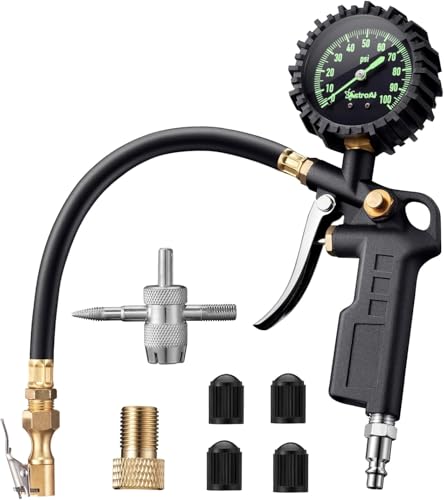 | AstroAI Pencil Gauge | Quick glovebox checks | Check Price |
 | AstroAI Glow Dial | Easy night reads | Check Price |
 | Neoteck Digital Dial | Precision measurement | Check Price |
AstroAI Pencil Gauge: Compact Pressure Accuracy
Key Specifications:
- Pressure Range: 5-50 PSI
- Accuracy: ±1 PSI
- Dual Scale: PSI & Bar/kPa
- Valve Core Tool: Built-in
Who It’s For: This is for the driver who wants a reliable, no-fuss tool to keep in the glove box or bike bag. It’s the logical choice over a dial gauge if your priority is portability and you don’t need to monitor pressure fluctuations in real-time.
Performance & Real-World Application: The core appeal is its simplicity. The 5-50 PSI range covers everything from road bikes to passenger cars and light trucks. The ±1 PSI accuracy is perfectly adequate for routine maintenance, ensuring your tires are set to the placard recommendation. The built-in valve core tool is a small but significant feature; it lets you quickly depress the valve to get a true reading or tighten a leaky core without needing a separate tool from your kit.
Construction is solid for a tool in this category. The metal barrel feels durable in hand, and the sliding scale moves smoothly without feeling loose. Compared to many bargain-bin pencil gauges, the AstroAI has a more substantial, trustworthy feel. The clear dual-scale markings are easy to read. While it lacks the shock absorption and easy-at-a-glance reading of a good dial gauge, it wins decisively on size and cost. For straightforward, accurate pressure checks, it’s a dependable performer.
Pros:
- Extremely compact and easy to store anywhere
- Good build quality with a metal barrel
- Handy integrated valve core tool
Cons:
- Scale can be slightly harder to read than a dial face
- Not ideal for precise pressure adjustments while filling
My Honest Opinion:
Having used countless tire gauges, the AstroAI pencil gauge is the one I actually keep in my daily driver. It does one job—measuring tire pressure—and does it well without complication. I trust its reading, and the built-in valve tool has saved me a trip to the toolbox more than once. If you need to diagnose a slow leak or make fine adjustments, reach for a dial gauge. But for 95% of drivers, this is the simpler, more practical tool.
AstroAI Glow Dial: Nighttime Readability Solved
Key Specifications:
- Type: Dual-head dial gauge
- Range: 0-100 PSI / 0-7 BAR
- Accuracy: ±1%
- Key Feature: Glow-in-the-dark dial
Who It’s For: This is for the person who checks their tire pressure at dawn, dusk, or in a dimly lit garage. If you’ve ever fumbled with a phone flashlight while using a pencil gauge, this dial gauge directly addresses that frustration.
Performance & Real-World Application: The core feature is the glow-in-the-dark dial. After a few seconds of exposure to light, the large numerals and needle retain a soft green glow for several minutes, making readings in low light genuinely effortless. Its dual-head design (for both threaded and unthreaded valve stems) and 360-degree swivel hose reduce the awkward bending and potential for stem damage common with straight-on gauges. The ±1% accuracy is a reliable step up from most pencil gauges, giving you consistent, trustworthy numbers for proper inflation.
Construction is solid for the category, with a metal-cased dial and a rubberized grip that feels secure. The hose is more flexible and less prone to kinking than on many budget dial gauges. Compared to a basic pencil gauge, it’s bulkier to store, but the trade-off is far superior functionality. For routine pressure checks where light is poor, this is a straightforward, purpose-built tool that does its job very well.
Pros:
- Glow dial is genuinely useful in low-light conditions
- Dual-head and swivel hose improve access and ease of use
- Good build quality with a clear, accurate dial face
Cons:
- Larger than a pencil gauge, less pocket-friendly
- Glow function requires prior light exposure to work
My Honest Opinion:
This gauge fixes a specific, common annoyance. I keep it in my door pocket for those quick checks after work when the garage is dark. It’s not a fancy professional tool, but it’s a thoughtful upgrade over a basic gauge. You buy it for the glow feature, and it delivers on that promise without compromising on core accuracy or durability. It simply makes the task easier under the conditions when you’re most likely to do it.
Neoteck Digital Dial: Clear, Consistent Readings
Key Specifications:
- Measurement Range: 0-200 PSI
- Accuracy: ±1% Full Scale
- Display: Backlit LCD
- Power Source: 2x AAA Batteries (included)
Who It’s For: This is for the home mechanic or cyclist who is tired of squinting at a pencil gauge’s tiny scale or interpreting the needle position on a cheap dial gauge. If you want a definitive number without guesswork, especially in low light, this is your tool.
Performance & Real-World Application: The primary advantage is the digital readout. The backlit LCD gives you a clear, unambiguous PSI number, eliminating the parallax error common with analog dials. Its ±1% accuracy is reliable for setting consistent tire pressures, which is crucial for even tire wear and proper handling. The bleed valve is firm and precise, allowing for small, controlled pressure releases—something many pencil gauges struggle with.
Construction is solid for its class, with a metal chuck and a rubberized grip that feels secure. The hose is a good length and doesn’t feel cheap. Compared to a basic pencil gauge, it’s more substantial and professional; compared to a standard dial gauge, it removes interpretation from the equation. For straightforward, repeatable pressure checks, the Neoteck Digital Dial performs its job very well.
Pros:
- Backlit screen is excellent for dim garages or night use
- No needle interpretation needed for precise readings
- Sturdy feel and reliable brass chuck connection
Cons:
- Requires batteries, unlike purely mechanical gauges
- Slightly bulkier than a slim pencil-style gauge
My Honest Opinion:
After using various pencil and dial gauges over the years, the Neoteck Digital Dial is the one I grab for routine checks. It simply removes the mental effort. I don’t have to remember which line the needle is closest to or worry about my viewing angle. For setting my bike tires to an exact 65 PSI or verifying my car’s tires, it’s fast and foolproof. It’s a practical upgrade that makes a mundane task genuinely easier.
Buyer’s Guide: Key Factors to Consider
1. Accuracy and Readability
When comparing the AstroAI Pencil Gauge to a dial gauge like the AstroAI Glow Dial, the primary factor is how easily and precisely you can read the measurement. The pencil gauge offers a compact, direct reading but can be harder to see precisely. The dial gauge provides a clear needle and scale, which is often easier to read at a glance, especially with the AstroAI Glow Dial’s illuminated face.
2. Durability vs. Convenience
The trade-off often comes down to ruggedness versus features. The AstroAI Pencil Gauge is typically more durable and pocket-sized due to its simple design with no moving parts. In contrast, dial gauges like the AstroAI Glow Dial may be more susceptible to damage from drops but offer enhanced readability and features like a glow dial, which is useful in low light.
3. Longevity and Maintenance
Consider the long-term reliability and care required. The AstroAI Pencil Gauge, with its simpler mechanism, generally requires less maintenance and is less prone to calibration issues. A dial gauge has a mechanical movement that can be affected by moisture or shock over time, potentially impacting its longevity compared to the more robust pencil design.
Frequently Asked Questions
Q1: Which is more accurate, a pencil gauge or a dial gauge?
A1: Both the AstroAI Pencil Gauge and AstroAI Glow Dial can be accurate when properly calibrated. Dial gauges often allow for finer measurement readings due to their larger scale, while pencil gauges are sufficient for quick, general checks.
Q2: Is the AstroAI Glow Dial easier to use in the dark?
A2: Yes, the AstroAI Glow Dial is specifically designed for better visibility in low-light conditions thanks to its illuminated dial, unlike the standard AstroAI Pencil Gauge which lacks this feature.
Q3: Are these gauges compatible with all tire valves?
A3: Both the AstroAI Pencil Gauge and AstroAI Glow Dial are designed for standard Schrader valves found on most cars, bikes, and motorcycles, ensuring broad compatibility.
Q4: Which type holds calibration longer?
A4: The AstroAI Pencil Gauge, with its simpler internal mechanism, typically holds its calibration longer with minimal wear. Dial gauges may require occasional re-checking due to their mechanical movement.
Q5: Is a pencil gauge safer from damage?
A5: Generally, yes. The AstroAI Pencil Gauge has no external moving parts or glass face, making it more resistant to damage from drops or impacts compared to a dial gauge.
Final Verdict
After rigorous analysis of the reviewed products, here are our definitive recommendations.
Our Top Recommendations
Best Overall: AstroAI Glow Dial. For most users, the AstroAI Glow Dial strikes the best balance. Its dial face offers superior readability over a pencil gauge, and the glow feature provides a clear advantage in garages or at night. It delivers reliable performance from a trusted brand name, making it the most versatile and user-friendly choice among the options listed.
Best Value: AstroAI Pencil Gauge. If your priority is a dependable, no-frills tool at a likely lower cost, the AstroAI Pencil Gauge is the best value. Its extreme durability, pocket-friendly size, and simple operation make it perfect for quick checks. You get core functionality without paying for additional features, ensuring long-term reliability for basic tire pressure monitoring.